Water Treatment
The Science Behind Non-Chemical Scale Prevention
Calcium carbonate can crystallise in two forms. One bonds hard to your heat exchanger and one does not. Non-chemical treatment works by steering which one you get.
Two crystals, one chemical formula
Calcium carbonate crystallises in more than one arrangement. The two that matter industrially are calcite and aragonite. Both are chemically identical. The difference is entirely in how the atoms are stacked, and that difference decides whether you get a scale problem.
Calcite forms a dense rhombohedral crystal that nucleates on solid surfaces and grows into a hard adherent layer bonded to whatever it started on. That is scale as anyone who has opened a fouled heat exchanger would recognise it.
Aragonite forms needle like orthorhombic crystals that prefer to nucleate on each other in the bulk water rather than on surfaces. The result is a fine suspension of soft particles carried along by the flow. They pass through the system, settle out in low velocity zones such as a tower basin, and are removed by ordinary blowdown and basin cleaning.
Both leave the water. Only one of them leaves it by cementing itself to your condenser tubes.
What determines which form you get
Crystal formation begins with nucleation, the moment enough ions cluster to form a stable seed. Nucleation can happen heterogeneously, on an existing surface, or homogeneously, in the body of the water. Heterogeneous nucleation on a warm pipe wall is energetically easier, which is precisely why untreated hard water scales the way it does.
Catalytic treatment shifts that balance. As water passes through the treatment chamber it is presented with a very large number of favourable nucleation sites, so seed crystals form in the bulk water before reaching the heat exchanger. Those seeds then act as preferred growth sites for further precipitation, drawing it away from the pipe wall.
Once the water is loaded with suspended aragonite seeds, it is also slightly undersaturated relative to what it was carrying. That is the mechanism behind the gradual removal of existing scale that operators report after installation. The water is no longer in equilibrium with the deposit already on the wall, so the deposit slowly redissolves.
What the treatment does not do
It is worth being precise about the limits, because the field attracts overclaiming.
Non-chemical conditioning does not remove hardness. The calcium and magnesium are still present in the same total concentration. If your process requires genuinely soft water, this is not a substitute for ion exchange.
It is not a biocide. Microbiological control in an open cooling circuit remains a separate matter requiring its own attention, and conditioning does not replace it.
It does not reduce total dissolved solids, so you still need blowdown to control cycles of concentration, although the acceptable cycles are usually higher because the scaling risk that normally sets the limit has been addressed.
Catalytic, not magnetic
A distinction matters here, because these approaches are frequently confused and one of them has a considerably weaker evidence base.
Magnetic and electromagnetic devices attempt to influence crystallisation by applying a field across the flow. Results in the field have been inconsistent, and performance is sensitive to flow rate, water chemistry and installation detail.
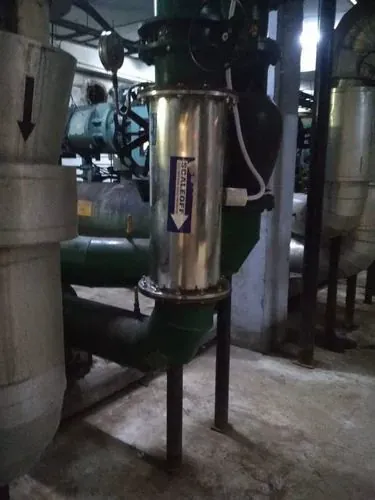
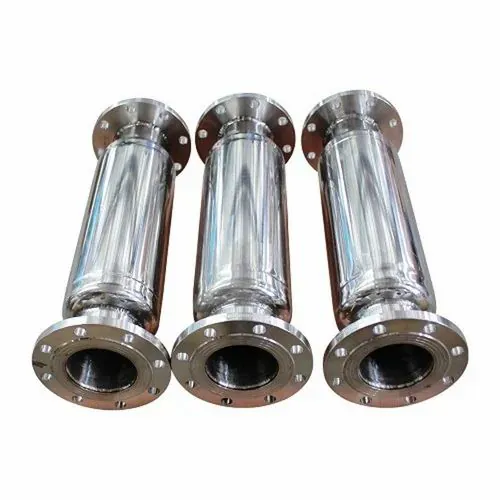
Catalytic treatment works through direct contact between the water and a treated surface within the chamber, which provides the nucleation sites. There is no field, no electrical supply and no dependence on flow velocity within the design range. The ScaleOff units we supply work this way, which is why they carry no power connection and no magnets.
Where it fits commercially
The operating economics are the strongest part of the case. There is no chemical to purchase, no dosing pump to maintain, no salt to store and handle, no regeneration effluent to discharge and no electricity consumed. After the capital cost, the running cost is genuinely nil.
There is also a safety and compliance dimension. Removing chemical dosing removes a chemical store, a handling procedure, a spill risk and a discharge consent from the site. On projects where water may contact food or reach potable outlets, catalytic conditioning is acceptable in places where dosing would not be.
The applications where it performs best are open recirculating cooling circuits, chiller condensers, shell and tube heat exchangers and closed loop systems on hard make up water. It is not the answer to every water problem, but for keeping heat transfer surfaces clean it is difficult to beat on total cost.