Cooling Towers
How Cooling Towers Work: Types, Components and Maintenance
How a cooling tower actually rejects heat, what separates counter flow from cross flow, what every component does, and the maintenance that keeps a tower at its design approach temperature.
What a cooling tower actually does
A cooling tower is a heat rejection device. It takes warm water returning from a condenser or a process, spreads it thinly over a large surface, and passes air through it. A small fraction of the water evaporates, and because evaporation consumes a great deal of energy, the water left behind leaves the tower measurably colder.
That last point is worth dwelling on, because it explains almost every design decision that follows. The cooling does not come from the air being cold. It comes from evaporation. This is why a tower is sized against wet bulb temperature, which accounts for humidity, rather than the dry bulb temperature on a thermometer.
Three numbers describe the duty. Range is the temperature drop across the tower. Approach is how close the cold water gets to the ambient wet bulb. Heat load is the total energy being rejected. A tower with a tight approach is doing harder work and will always be physically larger than one with a loose approach at the same heat load.
Counter flow and cross flow
Induced draught towers, which cover most industrial installations, come in two arrangements that differ in how air meets water.
In a counter flow tower, air travels vertically upward against water falling vertically downward. The two move in directly opposite directions, which gives the most effective heat and mass transfer and therefore the closest achievable approach. Counter flow towers tend to be taller and need higher pump head for the pressurised spray distribution.
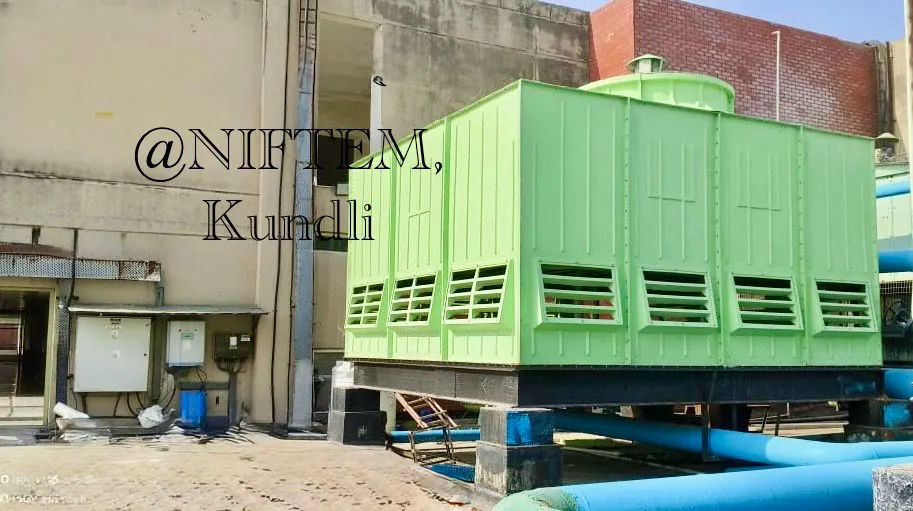
In a cross flow tower, air moves horizontally through louvres on the sides while water falls vertically through the fill. Distribution is by gravity from an open hot water basin at the top, which means lower pump head and much easier visual inspection of the distribution. Cross flow towers are generally shorter and wider than their counter flow equivalents.
Neither is universally better. Counter flow suits tight approaches and constrained plan area. Cross flow suits sites where pump head is expensive and where operators want to see the distribution working without shutting the tower down.
The components that determine performance
Strip a tower back and there are six parts that matter.
- Fill. The single biggest influence on thermal performance. Film fill made from thin corrugated PVC sheets creates an enormous water surface in a small volume. Splash fill breaks water into droplets instead and tolerates dirty water better at the cost of efficiency.
- Distribution. Sprinkler heads or fixed nozzles in counter flow, an open gravity basin in cross flow. Uneven distribution leaves parts of the fill dry, and a dry patch does no cooling at all.
- Drift eliminators. Closely spaced blades that force the leaving air to change direction several times, throwing entrained droplets back into the tower. Without them you lose treated water to the atmosphere and deposit it on everything nearby.
- Fan and drive. An axial fan pulls air through the fill. Direct drive suits small towers, belt drive is common in the middle range, and right angle gearboxes handle large cells.
- Basin. Collects the cooled water and holds the make up float valve, overflow, drain and outlet strainer.
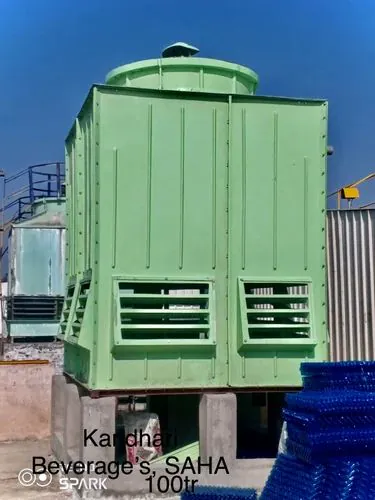
- Casing and structure. In an FRP tower this is a moulded shell that carries no corrosion risk, which is the principal reason FRP has displaced timber and mild steel in most applications.
Why water chemistry is the real maintenance issue
Because a tower works by evaporating water, everything dissolved in that water stays behind and concentrates. Feed water at 200 ppm hardness running at five cycles of concentration means circulating water at around 1000 ppm. That concentrated water is in constant contact with the hottest surfaces in your plant.
Calcium carbonate is the usual culprit. It has the awkward property of becoming less soluble as temperature rises, so it deposits preferentially on exactly the heat transfer surfaces you need clean. A scale layer is a very effective insulator, and a millimetre on a condenser tube can add a double digit percentage to compressor energy.
You have three levers. Increase blowdown to hold concentration lower, which wastes water. Dose an inhibitor chemically, which adds recurring cost and a handling burden. Or condition the water so that the hardness precipitates as a soft suspension rather than a bonded scale, which is the approach non-chemical treatment takes.
A maintenance schedule that holds performance
Cooling towers rarely fail suddenly. They degrade, and the degradation shows up as a rising approach temperature long before anything breaks. Trending cold water temperature against wet bulb is the cheapest diagnostic available.
- Weekly: check basin level and float valve, look for uneven distribution or dry fill, listen for bearing and gearbox noise, and confirm no visible drift is leaving the tower.
- Monthly: clear the outlet strainer, check belt tension, compare motor current against the nameplate, and record cold water temperature alongside ambient wet bulb.
- Quarterly: inspect the fill for clogging and biofilm, clear blocked nozzles, verify drift eliminators are seated, and check the fan blade pitch is uniform across the hub.
- Annually: drain and clean the basin fully, inspect the structure and panel fixings, service or replace bearings and drives, and renew fill if flutes are fouled beyond cleaning.
When to repair and when to replace
Most towers that no longer hold their approach do not need replacing. They need the fill renewed, the nozzles cleared and the drift eliminators refitted. Fill degrades faster than anything else in the tower, and renewing a pack typically restores rated duty for a small fraction of the cost of a new unit.
Replacement genuinely makes sense when the structure itself has failed, which on timber and mild steel towers means rot and corrosion, or when the plant load has grown beyond what the existing tower can serve. If you are unsure which situation you are in, measure the approach against design before spending anything.